
Why Is My Garage Floor Coating Peeling or Bubbling?
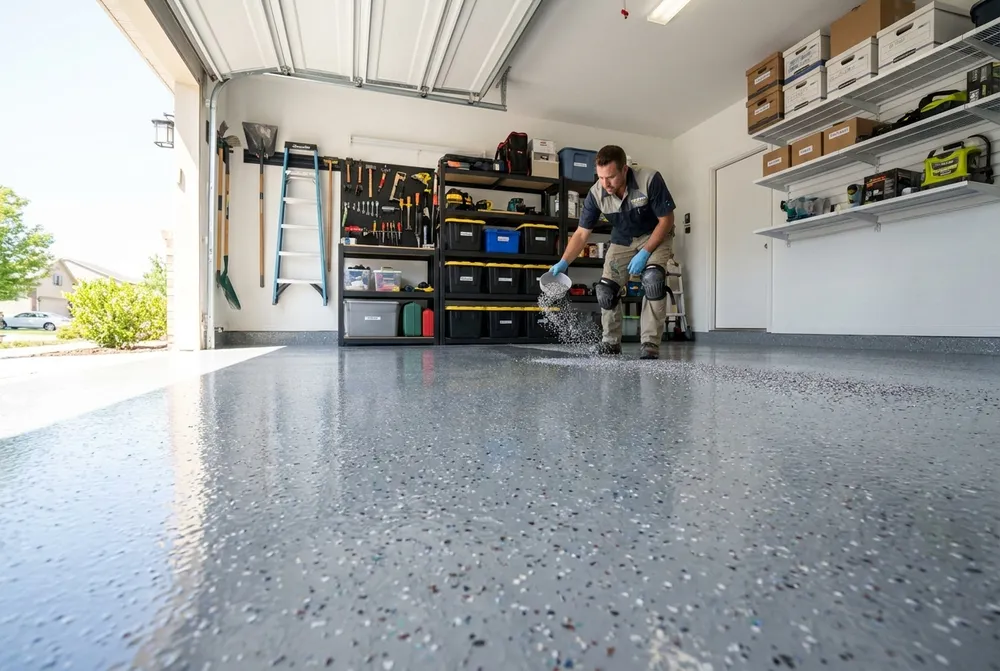
A garage floor coating peels or bubbles for one of three reasons: moisture trapped under it, a slab that was never diamond ground before coating, or freeze-thaw water and road salt working under the edges. All three trace back to prep, not the coating brand. Grove City Coatings grinds the concrete and checks slab moisture on every job, backed by a 25-year limited warranty.
If your garage floor coating is lifting at the edges or bubbling in spots, the coating itself is usually not the problem. What is underneath it, and how it was put down, almost always is.
What causes a garage floor coating to peel or bubble?
Three things cause most garage floor coating failures: trapped moisture, a slab that was never properly prepped, and repeated water and salt working into gaps at the edges. A national guide from Titan Garage Floors lists the same causes we see. Trapped moisture. A dirty slab. Big temperature swings during the install. Traffic before the coating cures. Cheap epoxy or paint. Coating spread too thick or too thin, which traps air. Every one of those, except long-term wear, is a prep or install mistake, not a flaw in the coating itself.
That is why Grove City Coatings treats prep as the real product, not a step before the real product. We diamond grind the bare concrete on every garage floor, epoxy, and metallic epoxy job. The grind opens the top of the slab so the coating locks into it instead of resting on a smooth surface. Skip the grind, and even a good coating has nothing to hold onto.
See our garage floor coating system for how the full process works, start to finish.
Why does moisture under the coating cause bubbling?
Moisture under a coating pushes up as vapor with nowhere to go, and that pressure shows up as a bubble or a soft spot that eventually splits open. Concrete is porous, so it can hold moisture from the ground underneath it even when the surface looks dry. A coating rolled over a damp slab traps that moisture, and it works its way back out over time.
This is why Grove City Coatings checks slab moisture as a real cost factor, not an afterthought, on both garage floors and basement epoxy jobs. When a slab tests wet, it gets a moisture-tolerant primer before anything else goes down. Skipping that test is one of the fastest ways to get a coating that looks fine for six months and then bubbles.
Do freeze-thaw and road salt make peeling worse in eastern Idaho?
Yes. Blackfoot winters cross the freezing line almost every day. The nearest official weather station, in Pocatello, shows a typical January high near 34 degrees and a low near 17 (NOAA 1991-2020 records). The floor warms by day and freezes again at night, most of the winter, not just once. Meltwater and road-salt brine that gets under an unground, poorly bonded coating expands every night it refreezes. That is a mechanical, climate-driven cause of lifting, on top of anything the coating material itself is doing.
A garage floor coating sealed against oil, road salt, and freeze-thaw only holds up to that cycle if the seal is actually bonded to the concrete underneath it. That is the same diamond-grind and crack-repair prep this guide keeps coming back to, because in this climate it is not optional.
Get a free look at your floor. Request your written quote and Frank will tell you honestly whether your floor needs a full redo or just a repair.
Can a peeling coating be fixed without stripping the whole floor?
Sometimes. It depends on how much of the floor has actually failed. A small area of bubbling or lifting near one edge can often be ground out, repaired, and recoated in that spot. A floor that is peeling in multiple places, or where the coating separates easily when you pull at an edge, usually means the whole surface never bonded and needs to come off.
On a grind-and-seal job, Grove City Coatings already grinds off any old paint or coatings before resealing, so removing a failed coating is normal work for us, not a special case. Frank inspects the floor in person to tell you honestly which situation you are in before any work starts.
If a full recoat makes more sense than a spot repair, see what a new garage floor coating costs for what drives that price.
How do you stop a new coating from peeling?
Three things prevent a new coating from failing the same way: a full diamond grind before coating, a moisture check with a primer when the slab needs it, and letting the coating cure fully before you park on it or drive on it. Grove City Coatings builds all three into every job, and backs the result with a 25-year limited warranty.
If your garage just needs a tough, low-cost surface rather than a full coated system, a grind and seal finish skips the coating material entirely and still gets the same prep. And if you are comparing garage floors against other rooms in the house, see the full lineup of concrete floor coatings we install across eastern Idaho.
A peeling floor is frustrating, but it is fixable, and it is preventable the next time around. Get your free written quote. Frank inspects the concrete in person, checks it for moisture, and tells you plainly what it needs before any work starts.
Talk to Grove City Coatings
Questions about your concrete coatings job? We serve Blackfoot and the surrounding area with honest, upfront advice.
Related articles
FAQ
Related questions
Does hot tire pickup cause the same kind of damage as peeling?
Hot tire pickup is a different problem with the same root cause. A warm tire can pull up small chunks of a coating that never bonded well to the slab. Both hot tire pickup and peeling come back to the same fix: a full diamond grind before coating, so the coating grips the concrete instead of sitting on top of it.
How long does a repaired garage floor coating last?
A repaired floor lasts as long as a new one when it is done right. Grove City Coatings grinds off the old, failed coating first, checks the slab for moisture, and repairs any cracks before recoating. Every floor we install, first time or redo, carries a 25-year limited warranty.
Does a DIY epoxy kit peel faster than a professional system?
A DIY kit skips the step that matters most: grinding the concrete. Most box-store kits ask you to clean and etch the floor, not grind it, so the coating sits on the surface instead of bonding into it. That is a common reason DIY floors peel within a year or two, while a ground and properly primed professional system is built to last for decades.